
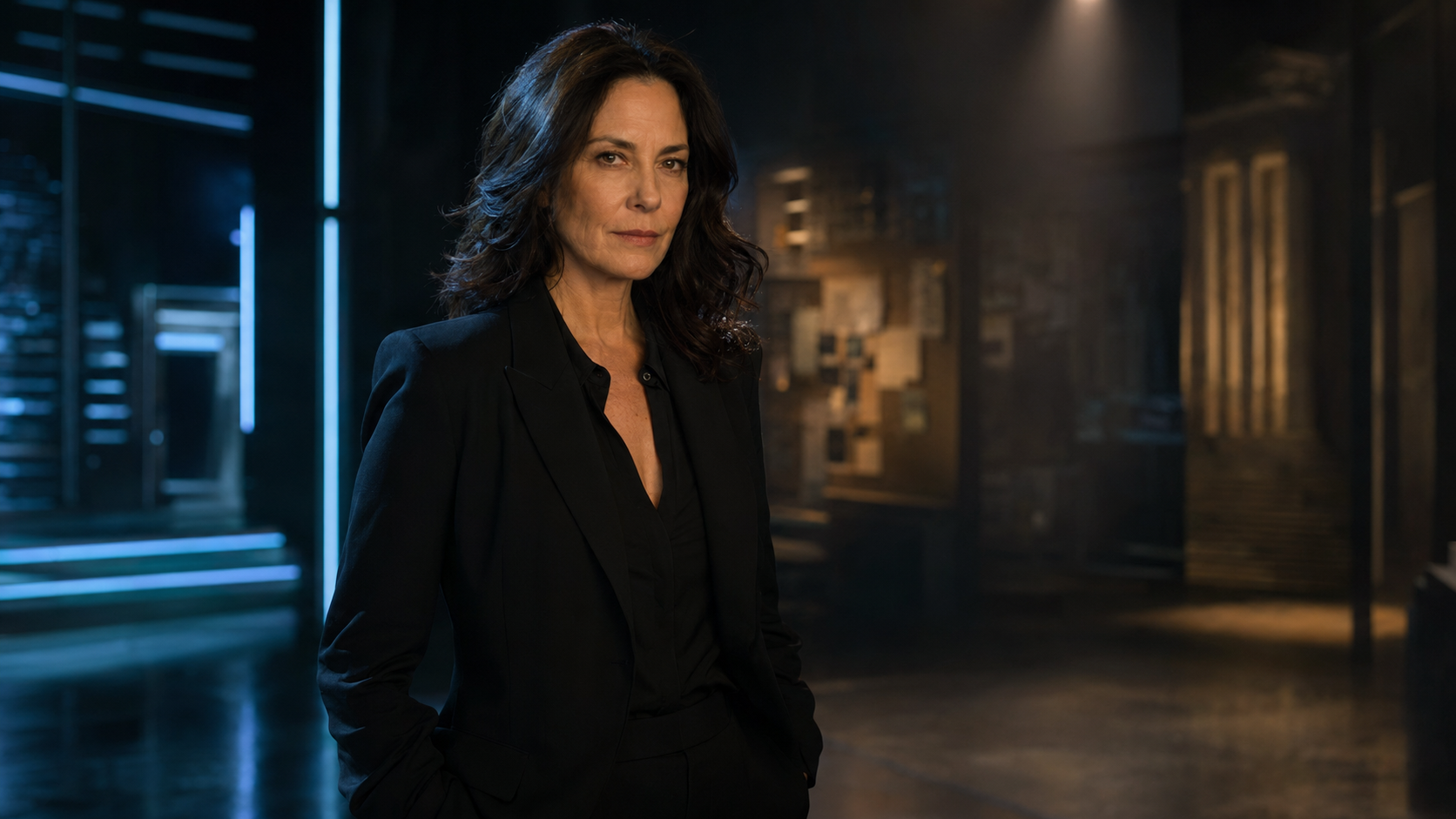
Some actors become famous because they play one enormous role for ten seasons. Others build their reputations differently. They arrive in a series, change the emotional temperature, leave viewers wanting more, and then move on to another completely different character.
Michelle Forbes belongs firmly in the second group.
Even if you do not immediately recognize her name, there is a good chance you have seen her somewhere. Perhaps you remember her as the defiant Ro Laren in Star Trek: The Next Generation. Maybe you watched her create havoc as Maryann Forrester in True Blood. You might know her best as the grieving Mitch Larsen in The Killing or as Admiral Helena Cain in Battlestar Galactica.
That list alone would be enough for a respectable television career. Michelle Forbes, however, has appeared in everything from daytime soap operas and science-fiction classics to crime dramas, independent films, political thrillers, and video games.
What makes her career especially interesting is that her characters rarely feel interchangeable. She has a talent for playing women who are intelligent, guarded, unpredictable, and sometimes a little frightening. Even when she appears in only a few episodes, she tends to leave behind the sort of character fans continue discussing years later.
Let’s take a closer look at Michelle Forbes, her early life, career highlights, awards, and the qualities that have made her such a respected screen performer.
Who Is Michelle Forbes?
Michelle Forbes is an American actress known for her work in television, film, theatre, and voice acting. She was born Michelle Renee Forbes Guajardo on January 8, 1965, in Austin, Texas.
According to her official Television Academy biography, she has appeared in major productions including Guiding Light, Star Trek: The Next Generation, Homicide: Life on the Street, True Blood, and The Killing. Her performance in The Killing earned her a Primetime Emmy nomination for Outstanding Supporting Actress in a Drama Series in 2011. The Television Academy
Forbes is often described as a character actress, although that term can undersell what she does. A character actor does not simply play unusual supporting roles. The best ones create complete people with limited screen time. They make you imagine that the character had a complicated life before entering the story and will continue having one after leaving it.
That is something Forbes does exceptionally well.
Michelle Forbes’ Early Life
Michelle Forbes grew up in Austin, Texas. During her younger years, she trained in ballet and initially imagined that dance might become her professional path.
Acting eventually took over.
She entered the entertainment business at a relatively young age and moved to New York, where she began building a professional career. Like many actors, she did not start with a glamorous movie premiere and a crowd of photographers shouting her name. Her early breakthrough came through daytime television, a demanding environment where performers often work through enormous amounts of dialogue at an unforgiving speed.
Honestly, soap operas may be one of the toughest acting schools around. There is little time to stare thoughtfully out of a window while waiting for inspiration to arrive. The cameras are ready, the pages keep coming, and the scene has to work.
That experience gave Forbes an excellent foundation.
Her Breakthrough on Guiding Light
Michelle Forbes received significant early attention for appearing on the long-running soap opera Guiding Light. She played the dual roles of Sonni Carrera Lewis and Solita Carrera.
Playing two characters in the same production is not merely a matter of changing clothes and hoping the audience keeps up. Each person needs a distinct voice, physical presence, rhythm, and emotional identity. Forbes managed to make the roles feel separate rather than like a television trick.
Her performance brought her a Daytime Emmy nomination in 1990 for Outstanding Supporting Actress in a Drama Series.
The role established several qualities that would follow her throughout her career. She could handle emotionally intense material, portray complicated women, and keep viewers slightly uncertain about what her character might do next.
Those abilities made her a natural fit for science fiction.
Ro Laren and the Star Trek Legacy
For many viewers, Michelle Forbes will always be Ro Laren.
Before taking on that character, Forbes appeared in a different role during the fourth season of Star Trek: The Next Generation. She played Dara in the episode “Half a Life.” The performance made a strong impression, and she later returned to the series as the Bajoran Starfleet officer Ro Laren.
Ro first appeared in the fifth-season episode named after her. She was not the kind of officer audiences normally met aboard the Enterprise. She was angry, suspicious, politically complicated, and uncomfortable with authority. She had been court-martialed, carried deep resentment connected to the Cardassian occupation of Bajor, and did not immediately trust Starfleet’s polished ideals.
That tension made her fascinating.
Captain Jean-Luc Picard represented discipline, diplomacy, and faith in the institution. Ro brought the perspective of someone whose life had shown her that institutions could fail vulnerable people. She did not reject every Starfleet value, but she was unwilling to accept those values without testing them.
Forbes never softened Ro into an easily lovable rebel. She allowed the character to be difficult. That choice gave Ro an honesty that still feels fresh.
She also helped introduce Bajoran history and identity before Star Trek: Deep Space Nine expanded that part of the fictional universe. Ro’s appearances gave viewers a personal connection to the suffering, anger, and displacement experienced by the Bajoran people.
Why Ro Laren Remained So Popular
Ro Laren appeared in a relatively small number of episodes, yet she became one of the most memorable recurring characters in The Next Generation.
Part of that popularity came from the writing, but much of it came from Forbes’ performance. She communicated years of disappointment through a glance or a guarded response. Ro could be confrontational without becoming one-dimensional, and vulnerable without suddenly losing her edge.
She was also allowed to disagree with Picard in meaningful ways. Their relationship was built on respect, frustration, disappointment, and a strange form of affection. It felt less like a simple captain-and-officer arrangement and more like the relationship between a demanding mentor and a talented person who could never fully accept the mentor’s world.
Ro’s story appeared to end in 1994 when she left Starfleet and joined the Maquis. For decades, fans wondered what had happened to her.
Then, almost 30 years later, Michelle Forbes returned as Ro Laren in the third season of Star Trek: Picard. The episode finally allowed Ro and Picard to confront the pain and anger left unresolved by their last meeting. It was not merely a nostalgic cameo. It completed an emotional story that had been waiting since the 1990s. Entertainment Weekly
Few actors get the opportunity to revisit a character after nearly three decades. Even fewer make the return feel necessary.
Building a Career Beyond Science Fiction
Although science-fiction audiences have always appreciated Michelle Forbes, her career extends far beyond spaceships and futuristic politics.
During the 1990s, she appeared in several films, including Kalifornia, Swimming with Sharks, and Escape from L.A.
In California, she joined a cast that included Brad Pitt, Juliette Lewis, and David Duchovny. The dark thriller followed a group traveling across the United States while visiting locations connected to famous murders. Forbes played Carrie Laughlin, whose journey becomes increasingly dangerous as the truth about her traveling companions emerges.
She also appeared in Swimming with Sharks, a sharp Hollywood satire starring Kevin Spacey and Frank Whaley. The movie developed a cult following for its cynical picture of ambition, abuse, and workplace power.
These projects showed that Forbes could move comfortably between genre television, psychological thrillers, and biting drama.
She was never limited to being “the woman from Star Trek,” even if Ro Laren remained one of her most recognizable characters.
Homicide: Life on the Street
Michelle Forbes joined the acclaimed police drama Homicide: Life on the Street as Dr. Julianna Cox, the chief medical examiner.
The series was known for its realistic atmosphere, morally complicated stories, and dialogue-heavy performances. It did not present police work as a tidy sequence of clues followed by a conveniently timed confession. Cases could be frustrating, people could be wrong, and justice did not always arrive before the closing credits.
That environment suited Forbes.
Dr. Cox was intelligent and authoritative, but she was not written as a cold professional stereotype. She had personal relationships, ambitions, weaknesses, and conflicts that extended beyond her work in the medical examiner’s office.
Forbes played her with a controlled intensity. She did not need dramatic speeches in every scene. Often, the character’s confidence came through in the way she occupied a room and refused to be intimidated.
It was another example of Forbes taking a supporting character and giving her the weight of a lead.
Admiral Cain in Battlestar Galactica
If Ro Laren earned Michelle Forbes a permanent place in Star Trek history, Admiral Helena Cain helped secure her reputation with another generation of science-fiction fans.
Cain appeared in the reimagined Battlestar Galactica, particularly in the acclaimed “Pegasus” storyline. She commanded the Battlestar Pegasus and initially seemed like the powerful military leader humanity desperately needed.
Then the audience began learning what she had done to maintain control.
Cain was ruthless, disciplined, and willing to cross moral boundaries in the name of survival. Yet Forbes did not play her as a simple villain. She portrayed someone who genuinely believed extreme circumstances justified extreme decisions.
That distinction matters.
A cartoon villain knows they are evil and seems to enjoy it. Cain believed she was doing what survival required. Her confidence forced viewers to ask an uncomfortable question: how much humanity can people sacrifice while claiming they are saving humanity?
Forbes brought authority to the role immediately. You believed that crews would obey Cain, even when they feared her. She had the posture, voice, and emotional control of someone accustomed to being the most powerful person in the room.
Her performance became so closely associated with the character that she later returned for the television film Battlestar Galactica: Razor, which explored more of Cain’s history and leadership.
Michelle Forbes in True Blood
Michelle Forbes entered an entirely different television universe when she played Maryann Forrester in HBO’s supernatural drama True Blood.
Maryann initially appeared charming, generous, and mysterious. She welcomed people into her home, encouraged them to abandon their inhibitions, and seemed to offer freedom from ordinary social rules.
Naturally, because this was True Blood, the friendly gatherings did not remain harmless for long.
Maryann was eventually revealed to be a maenad, a supernatural follower of Dionysus who could manipulate people and push them toward uncontrolled behavior. Her presence turned the town of Bon Temps into one extremely messy party that no responsible neighbor would ever approve of.
Forbes clearly understood the tone of the series. True Blood combined horror, romance, satire, violence, and deliberate excess. Maryann needed to be seductive and threatening at the same time. Forbes played her with such relaxed confidence that the character often seemed most dangerous when she was being pleasant.
It was a wonderfully theatrical role, yet she kept Maryann grounded enough to remain genuinely unsettling.
Her Emmy-Nominated Performance in The Killing
One of Michelle Forbes’ most powerful performances came in AMC’s crime drama The Killing.
She played Mitch Larsen, the mother of murdered teenager Rosie Larsen. While the series followed detectives investigating the crime, it also spent considerable time showing how Rosie’s death affected her family.
Crime dramas sometimes treat victims as plot devices. A body is discovered, detectives study the evidence, and the victim’s family appears for a sad interview before the investigation moves forward.
The Killing took a more patient and painful approach.
Through Mitch, viewers saw grief as an ongoing condition rather than a single dramatic scene. Forbes portrayed shock, anger, guilt, exhaustion, and emotional isolation. Her performance was often quiet, which made it feel even more truthful.
She did not try to make Mitch consistently sympathetic. Grief does not always make people gentle or reasonable. Sometimes it makes them distant, selfish, confused, or impossible to comfort. Forbes allowed the character to behave badly without asking the audience to stop caring about her.
Her work earned a 2011 Primetime Emmy nomination for Outstanding Supporting Actress in a Drama Series. She also won a Saturn Award for her performance.
For anyone wanting to understand Michelle Forbes’ range, The Killing is essential viewing. There are no supernatural powers, futuristic conflicts, or military uniforms to support the character. There is simply a woman attempting to survive the worst event of her life.
Other Notable Television Roles
Michelle Forbes’ television résumé is impressively varied.
She appeared in 24 as Lynne Kresge, an adviser working within President David Palmer’s administration. The role placed her in the middle of political pressure, national-security decisions, and the show’s famously stressful real-time format.
She joined Prison Break as Samantha Brinker, a representative connected to the shadowy organization known as the Company. She also appeared in HBO’s In Treatment, the Canadian crime drama Durham County, and the conspiracy series Powers.

In Berlin Station, Forbes played Valerie Edwards, a senior CIA officer operating within a tense world of espionage and political uncertainty. Later, she appeared in Treadstone, a series connected to the Jason Bourne franchise.
There is a clear pattern here. Casting directors often turn to Forbes when a production needs a woman who can project intelligence and authority without becoming predictable.
Give her a government office, a military command, a secret agenda, or a room full of people hiding information, and she looks perfectly at home.
Voice Acting and Video Games
Michelle Forbes has also built a notable career as a voice performer.
Gamers may recognize her as Dr. Judith Mossman from the Half-Life 2 series. Mossman is another complicated figure whose loyalties and motivations are not immediately clear. Once again, Forbes found herself playing someone intelligent, secretive, and morally difficult.
At this point, it almost feels as if casting directors see the words “brilliant but possibly untrustworthy” and automatically reach for her phone number.
Voice acting requires a different type of control because performers cannot rely on facial expressions or physical movement. Emotion, hesitation, and hidden intention must all come through the voice.
Forbes’ naturally distinctive delivery works especially well in that setting. Her voice can sound calm and authoritative while still suggesting that the character knows far more than she is willing to reveal.
What Makes Michelle Forbes Such an Effective Actress?
Michelle Forbes rarely appears to be chasing the audience’s approval. That may be the most important part of her appeal.
Many of her characters are not designed to be instantly lovable. Ro Laren is confrontational. Admiral Cain is terrifyingly uncompromising. Maryann Forrester is manipulative. Mitch Larsen can be emotionally unreachable.
Forbes does not smooth away those difficult qualities. She commits to them.
She also understands restraint. Instead of announcing every emotion, she often lets it appear in small changes of expression, posture, or tone. That approach rewards attentive viewers because you feel as though you are discovering the character rather than being told exactly what to think.
Her performances often combine four qualities:
- Emotional control
- Quiet vulnerability
- Natural authority
- A sense of hidden history
Even when a script gives limited background information, Forbes makes it seem as if her character has already lived an entire life off-screen.
A Private Life Away From Celebrity Culture
Michelle Forbes has generally kept her private life separate from her public work. She has never built her career around constant publicity, lifestyle coverage, or social-media drama.
That privacy fits the shape of her career. She seems more interested in disappearing into characters than in turning herself into a permanent celebrity personality.
For audiences, it is important to respect that boundary. Public curiosity is understandable, but an actor does not owe the world access to every relationship, family matter, or personal decision.
What we can discuss confidently is her work, and there is plenty of it.
Michelle Forbes’ Net Worth
People frequently search for Michelle Forbes’ net worth, but reliable, publicly confirmed financial information is not available.
Celebrity net-worth websites often publish estimates without explaining how they obtained the numbers. These figures may be based on assumed salaries, property information, or general industry averages. They should not be treated as verified facts.
Forbes has worked steadily across television, movies, and games for several decades, so it is reasonable to assume she has enjoyed a successful professional career. Any precise dollar figure, however, would be speculation unless confirmed by Forbes or a trustworthy financial record.
Sometimes “successful actress with a long career” is the honest answer, even if it is less exciting than a suspiciously exact number on a celebrity website.
The Lasting Influence of Michelle Forbes
Michelle Forbes has never needed to dominate every episode to make an impact.
Her return as Ro Laren in Star Trek: Picard demonstrated how deeply viewers remembered a character she had last played in the 1990s. Her performance as Admiral Cain remains a regular subject of discussion among Battlestar Galactica fans. Her work in The Killing continues to stand as one of television’s more honest portrayals of parental grief.
That kind of staying power cannot be manufactured through publicity alone.
It comes from making strong choices, trusting the audience, and treating supporting characters as complete human beings. Forbes has repeatedly done all three.
Best Michelle Forbes Performances to Watch
If you are new to her work, this short viewing list is a good place to begin:
Star Trek: The Next Generation
Start with “Ensign Ro,” then explore episodes such as “Disaster,” “The Next Phase,” and “Preemptive Strike.” These episodes show Ro’s development and her complicated relationship with Starfleet.
Star Trek: Picard
Watch the third-season episode “Imposters” after seeing Ro’s original appearances. The emotional impact is much stronger when you understand her history with Picard.
Battlestar Galactica
The “Pegasus” storyline and Razor offer a compelling study of leadership, fear, and moral compromise.
True Blood
Season two allows Forbes to embrace a more extravagant supernatural role without losing the controlled presence that defines much of her work.
The Killing
This is arguably her most emotionally demanding television performance and the one that earned her Primetime Emmy recognition.
Homicide: Life on the Street
The series demonstrates how comfortably Forbes fits into intelligent, character-driven drama.
Frequently Asked Questions About Michelle Forbes
How old is Michelle Forbes?
Michelle Forbes was born on January 8, 1965. She turned 61 in January 2026.
Where was Michelle Forbes born?
She was born in Austin, Texas, in the United States.
What is Michelle Forbes best known for?
She is best known for playing Ro Laren in Star Trek: The Next Generation and Star Trek: Picard, Admiral Helena Cain in Battlestar Galactica, Maryann Forrester in True Blood, and Mitch Larsen in The Killing.
Did Michelle Forbes win an Emmy?
Michelle Forbes has received both Daytime and Primetime Emmy nominations, but she has not won an Emmy. Her performance as Mitch Larsen in The Killing earned her a 2011 Primetime Emmy nomination.
Did Michelle Forbes return to Star Trek?
Yes. She returned as Ro Laren in the third season of Star Trek: Picard in 2023, nearly three decades after her final appearance in The Next Generation.
Who did Michelle Forbes play in Battlestar Galactica?
She played Admiral Helena Cain, the commanding officer of the Battlestar Pegasus.
Who was Michelle Forbes in True Blood?
Forbes played Maryann Forrester, a mysterious supernatural figure who became the main antagonist of the show’s second season.
Was Michelle Forbes in Guiding Light?
Yes. She played Sonni Carrera Lewis and Solita Carrera on Guiding Light. The dual performance earned her a Daytime Emmy nomination.
Does Michelle Forbes appear in video games?
Yes. One of her best-known video-game roles is Dr. Judith Mossman in the Half-Life 2 series.
What is Michelle Forbes’ net worth?
No reliable public source has confirmed her exact net worth. Figures found on celebrity-finance websites should be viewed as estimates rather than facts.
Conclusion
Michelle Forbes has built the kind of career that becomes more impressive the longer you study it.
She has moved between soap operas, crime dramas, science fiction, horror, political thrillers, films, and video games without allowing herself to be trapped by one successful character. At the same time, she has created several roles that audiences have remembered for decades.
Her greatest strength may be her willingness to let characters remain complicated. She does not ask viewers to approve of every decision she makes. Instead, she makes us understand why they might make it.
That is why Ro Laren feels like more than a rebellious officer. It is why Admiral Cain remains disturbing rather than simply villainous. It is why Mitch Larsen’s grief feels uncomfortable, messy, and recognizably human.
Michelle Forbes may not always be the first name in the opening credits, but when she enters a story, you notice. And when she leaves, the story usually feels a little less dangerous, a little less mysterious, and a lot less interesting.
